

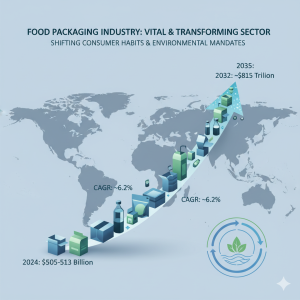
Food packaging industry is a vital, high-growth sector, undergoing a massive transformation spurred by shifting consumer habits and environmental mandates. The market was valued at approximately $505 to $513 billion in 2024 and is on a solid upward trajectory. Projections indicate the market is poised to exceed $815 billion by 2032 and could near $1 trillion by 2035, expanding at a Compound Annual Growth Rate (CAGR) of around 6.2%.
Global Market Snapshot
The primary drivers of this growth include rising global demand for convenience and ready-to-eat foods, accelerating urbanization, and increasing per capita disposable incomes.
The Asia Pacific region is the world’s largest market for food packaging, currently commanding an estimated 33% of the global share. It is also forecasted to be the fastest-growing regional market through 2035, driven by its large consumer base and expanding modern retail infrastructure. North America and Europe remain major markets, with Europe’s development increasingly influenced by stringent environmental regulations.
Download a Sample of Our Market Intelligence: https://www.towardspackaging.com/download-sample/5076
Segmentation Insights
By Material
Plastics hold the largest share of the market due to their cost-effectiveness, lightweight nature, and versatility. However, the regulatory and consumer push for sustainable alternatives is driving strong growth in other segments:
- Paper and Paperboard are experiencing significant growth, favored for their recyclability and role as sustainable alternatives, particularly in e-commerce and fast-food applications.
- Metal (cans, foils) and Glass maintain significant, stable shares, prized for their superior barrier properties, which offer extended shelf life for canned goods and premium appeal for certain beverages and preserved foods.
By Packaging Type and Application
Flexible Packaging (pouches, films, bags) is both the dominant format and the fastest-growing segment, primarily due to its low material requirements, reduced weight, and resulting lower logistics costs. Rigid Packaging (bottles, jars, cans) remains essential for products requiring maximum protection against light, moisture, and oxygen, such as dairy products.
The largest end-use application for food packaging is the Bakery & Confectionery segment.
Key Trends Shaping the Future
The industry’s future will be defined by innovation that balances performance with planetary health:
- The Sustainability Imperative: There is a pronounced industry-wide shift toward the circular economy. This involves aggressively moving to recyclable, compostable, and bio-based materials (such as plant-based plastics and fiber-based solutions) to reduce reliance on virgin plastics and address waste management challenges.
- Smart and Active Technology: Packaging is moving beyond mere containment. Active packaging technologies like oxygen scavengers and moisture regulators are now standard tools for extending shelf life. Meanwhile, Smart Packaging—integrating features like QR codes, RFID tags, and freshness indicators—is enhancing traceability, engaging consumers, and boosting food safety across the supply chain.
- Convenience and E-commerce: The rise of online grocery delivery, meal kits, and on-the-go consumption is driving demand for specific formats. Packaging must now be lightweight for shipping, durable for transit, and highly convenient for the end-user (e.g., resealable, microwaveable, and single-serving portions).
1. What is the biggest challenge the food packaging industry faces despite its strong growth forecast?
The biggest challenge is balancing the consumer demand for convenience with the non-negotiable requirement for sustainability. Traditional plastic, while cost-effective and functionally superior for preservation (extending the shelf life of food), is the primary contributor to environmental waste.
The industry is in a critical race to find alternative materials (like bioplastics and advanced paperboard) that are genuinely recyclable or compostable without compromising food safety or significantly increasing the cost to a level that prohibits mass adoption. Fluctuating raw material costs and evolving, strict global regulations also complicate this balance.
Invest in Our Premium Strategic Solution: https://www.towardspackaging.com/checkout/5076
2. How are companies using “Smart Packaging” to reduce the significant problem of food waste?
Smart Packaging is moving beyond just QR codes and is leveraging technology to actively preserve food and provide real-time status. The two main types are:
- Active Packaging: Solutions like Modified Atmosphere Packaging (MAP) and oxygen/ethylene scavengers are embedded into the packaging to directly slow down spoilage and extend the product’s shelf life. This is critical for fresh meats, poultry, and produce.
- Intelligent Packaging: This includes Time-Temperature Indicators (TTIs) and freshness sensors that visually alert the consumer or supply chain manager when a product is nearing spoilage, preventing unnecessary waste of perfectly good food.
3. Why is the Asia Pacific region dominating the market, and will this continue?
The Asia Pacific region currently holds the largest market share (around 33%) and is projected to be the fastest-growing market. This dominance is expected to continue for three main reasons:
- Urbanization and Middle Class Growth: Rapid development and rising disposable incomes in countries like China and India have dramatically increased the consumption of processed and packaged foods.
- Population Scale: The sheer size of the consumer base necessitates massive volumes of packaging for food distribution.
- Modern Retail Expansion: The proliferation of supermarkets, hypermarkets, and robust e-commerce channels requires consistent, durable, and highly protective packaging solutions for mass transit.
4. What is the primary difference between Flexible and Rigid packaging in terms of market dynamics?
| Feature | Flexible Packaging (Films, Pouches, Bags) | Rigid Packaging (Bottles, Cans, Jars) |
| Market Status | Dominant & Fastest Growing Segment | Major Share, but Slower Growth |
| Key Advantage | Lower material usage, reduced weight/transport cost, convenience (resealable). | Superior protection, better barrier properties, long-term shelf stability. |
| Primary Use | Snacks, processed meats, single-serve portions, frozen foods. | Beverages, dairy, canned goods, preserved foods. |
| Sustainability Trend | Shift to mono-materials for easier recycling; demand for compostable films. | Focus on using recycled content (rPET, recycled aluminum) and weight reduction. |
5. Are consumers willing to pay a premium for sustainable packaging, and how does this affect material choice?
Research increasingly shows that a significant segment of consumers is willing to pay a premium for products packaged in materials they perceive as environmentally friendly (e.g., paper/paperboard, biodegradable options).
This willingness is driving manufacturers to absorb the often higher initial cost of materials like bioplastics and recycled content to gain market share and enhance brand image. However, the largest demand remains at the mid-to-premium price point; for commodity items, cost-effectiveness remains the ultimate determinant of packaging material choice.
Source : https://www.towardspackaging.com/insights/insulated-packaging-market
Access our exclusive, data-rich dashboard dedicated to the respective market built specifically for decision-makers, strategists, and industry leaders. The dashboard features comprehensive statistical data, segment-wise market breakdowns, regional performance shares, detailed company profiles, annual updates, and much more. From market sizing to competitive intelligence, this powerful tool is one-stop solution to your gateway.
Access Now: https://www.towardspackaging.com/contact-us
Become a Valued Research Partner with Us – Schedule a meeting: https://www.towardspackaging.com/schedule-meeting
Request a Custom Case Study Built Around Your Goals: sales@towardspackaging.com
About Us
Towards Packaging is a global consulting and market intelligence firm specializing in strategic research across key packaging segments including sustainable, flexible, smart, biodegradable, and recycled packaging. We empower businesses with actionable insights, trend analysis, and data-driven strategies. Our experienced consultants use advanced research methodologies to help companies of all sizes navigate market shifts, identify growth opportunities, and stay competitive in the global packaging industry.
Stay Connected with Towards Packaging:
- Find us on Social Platforms: LinkedIn | Twitter | Instagram
- Subscribe to Our Newsletter: Towards Sustainable Packaging
- Visit Towards Packaging for In-depth Market Insights: Towards Packaging
- Read Our Printed Chronicle: Packaging Web Wire
- Get ahead of the trends – follow us for exclusive insights and industry updates:
Pinterest | Medium | Tumblr | Hashnode | Bloglovin | LinkedIn – Packaging Web Wire
- Contact: APAC: +91 9356 9282 04 | Europe: +44 778 256 0738 | North America: +1 8044 4193 44
Our Trusted Data Partners
Precedence Research | Statifacts | Towards Healthcare |TowardsAuto | Towards Automotive | Towards Food and Beverages | Towards Chemical and Materials | Towards Consumer Goods | Towards Dental | Towards EV Solutions | Nova One Advisor | Healthcare Webwire | Packaging Webwire | Automotive Webwire | Nutraceuticals Func Foods | Onco Quant | Sustainability Quant | Specialty Chemicals Analytics